SUPERSTORE FORTY-NINE
The signal knows who you are.
A customer complains in public and signs it with a handle no system recognizes. Returns of the same chair are climbing in a lakehouse another team owns. Nobody holds both facts at once. Forty-Nine connects them, and opens the case.
Same Superstore as 007. Same account owner. This time the complaint finds her first.
#The complaint with no name
Susan runs purchasing for one of Superstore's B2B accounts. She bought a line of office chairs. The chairs broke. She posted: "broke after a week. Seriously?" The post carries her handle and nothing else. No customer ID, no order, no account owner. Twenty-six percent of the posts in this build arrive like that.
Every fact needed to save that account already lives inside the company. No system holds them at the same time. Today the gap is a person swivel-chairing between three systems, per account, per incident. It has a name: signal-to-action latency. Forty-Nine closes it in one conversation, on Salesforce Data 360 and Agentforce.
#How it works
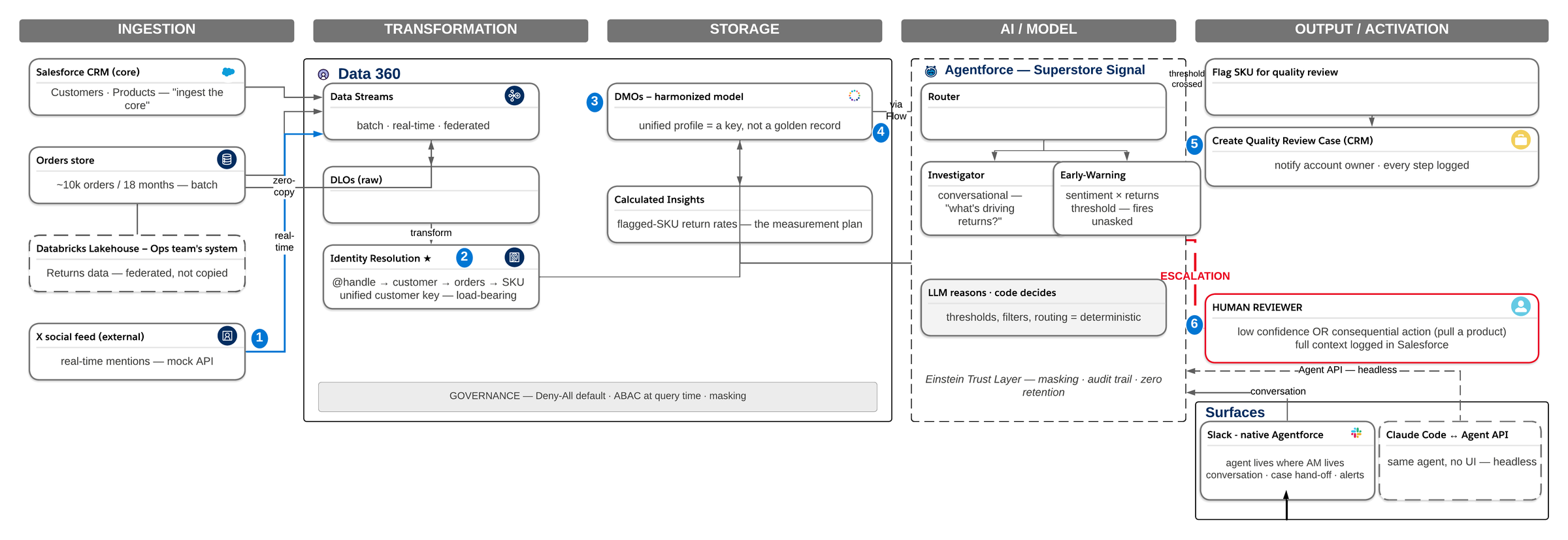
- Five sources, three ingestion patterns. Batch files for customers, products, orders, and the social feed. Zero-copy federation for returns, which live in another team's Databricks lakehouse and get queried where they sit. A SQL transform that derives the social authors from the posts. Three patterns because the silos are the premise. Copy everything into one lake and you've solved a different problem.
- Identity resolution. 804 customers plus 237 social authors: 1,041 links into 804 profiles, zero orphans. Every handle resolves.
@handle → customer → order → SKU → account owneris a walk, not a research project. - A router and two specialists. Superstore Signal hands off to an Investigator ("what's driving returns on this account?") and an Early-Warning agent that ranks SKUs by negative posts against return rate. The complaints lead. The returns lag.
- Three actions. That's all it gets. Three Apex actions, no free queries against the model. The one that matters opens a Case with the evidence chain inside, assigned to a person. A human works it.
- The model reads the language. The code makes the calls. Thresholds, filters, and routing are deterministic. The model runs inside the Einstein Trust Layer: masking, audit trail, zero retention.
- It lives in Slack. The agent runs where the account team already works. The same agent runs headless over the Agent API, no UI at all, through an admin-registered app with four named OAuth scopes and a pinned run-as user. Its reach was bounded before the first prompt arrived.
The claim I'd defend in any room: an agent's answer is exactly as trustworthy as the definitions underneath it. That's why the modeling and identity work is most of this build, and the agent is the small part on top.
Built solo, at portfolio scale. A demo-sized slice of the company: 10,000 orders, 804 customers, 840 federated returns, 510 posts. Big enough that identity resolution has work to do and the defect signal has to climb out of the noise. Small enough that every claim here checks in one SQL statement. The architecture is the part that holds at national scale.
#Try this
Ask your agent to do something. Then go find the record. A created case quotes its number back. A narrated one never does. No number, no case. Your agent just did the chat version of "I'll get right on that."
#What it taught me
- Zero-copy is a claim, so I checked it. The helper tool for the returns stream hardcoded an ingest mode. It would have batch-copied the data while I said "federated" out loud. I read the tool's source and hand-built the request. The Apex now reaches through Data 360 into the lakehouse at query time.
- Agents narrate intent. The first time I asked for a case, the agent said it would open one. It created nothing. The CRM said so. The fix is in the agent's own instructions: a case exists only when the action returns a case number.
- Constraints are the design. The org gated the object built to carry a social handle for matching. So the handle rides a contact point, the match rule is exact-normalized, and the trade-off is written down. Production uses custom party identifiers. Hit it, diagnose it, route around it, say so. That's the job.
- The trace is the proof. One turn, 23 steps: the router handoff, the bounded tools, a 5.2-second call against federated data, and the case number that came back, 00001027. You can only claim an agent behaves if you can watch it behave.